
When we look at the history of testing, it generally splits into two massive stories: Quality Control in Manufacturing (how we made sure physical machines didn’t fail) and Software Testing (how we make sure invisible code actually works).
The discipline has completely flipped over the decades. It used to be about finding mistakes after things were already made. Today, it’s about preventing mistakes before they ever happen.
Here is how testing evolved from assembly lines to artificial intelligence.
1. The Era of Physical Quality Control (Early to Mid-1900s)
Before computers existed, testing meant inspecting physical goods. In the early days of the Industrial Revolution, factories relied on simple “end-of-line” inspections—someone literally looking at a finished product to see if it was broken.
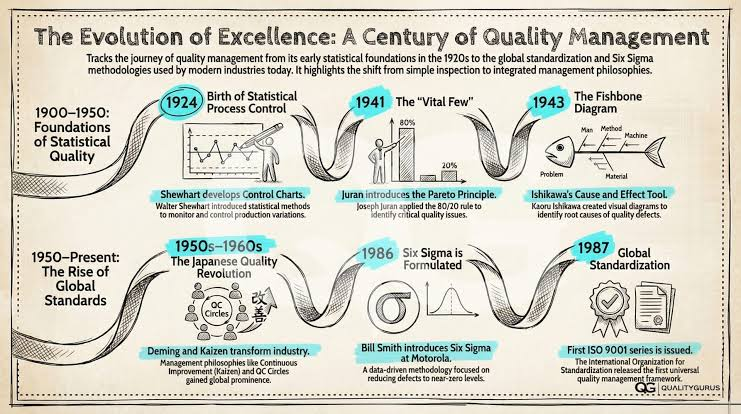
- 1924 (Statistical Sampling): Walter Shewhart at Bell Labs realized you didn’t have to test every single item. He introduced statistical quality control, using control charts to track production variations.
- 1940s–1950s (The Post-War Revolution): Thinkers like W. Edwards Deming and Joseph Juran took these concepts to Japan, completely reshaping manufacturing. Instead of catching bad products at the end, they introduced Kaizen (continuous improvement), focusing on fixing the factory processes so defects never happened in the first place.
2. The Dawn of Software Testing (1950s – 1970s)
When software first emerged, it was deeply tied to hardware. Early software testing wasn’t its own job; it was just something mathematicians and engineers did to make sure their giant calculators weren’t misbehaving.
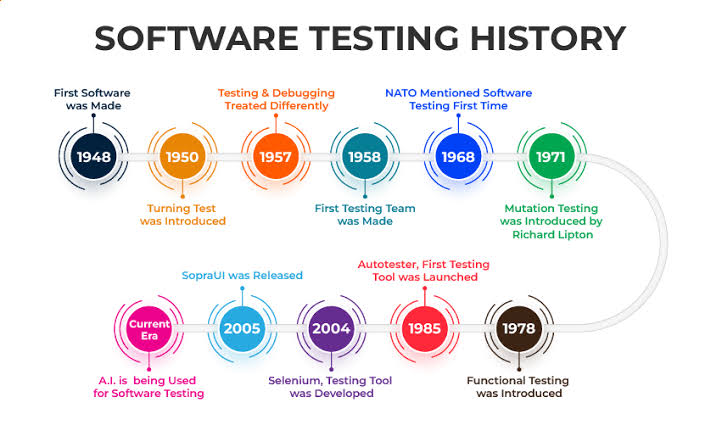
- 1957 (The Great Decoupling): Computer scientist Tom Gelperin noted that this was the year testing was finally treated as a distinct activity from debugging. Debugging was fixing known errors; testing was actively hunting for unknown ones.
- 1979 (The Mindset Shift): Glenford Myers published The Art of Software Testing. This book changed everything by defining testing as “the process of executing a program with the intent of finding errors.” Up until then, people tested to prove the software worked. Myers argued you should test to prove it failed.
3. The Methodology Boom (1980s – 1990s)
As software grew into a massive global industry, it needed structure. This era brought rigid, highly documented testing phases.
- The Waterfall Model: Testing was pushed entirely to the end of the development cycle. Developers spent months writing code, then threw it “over the wall” to a separate QA (Quality Assurance) team.
- The V-Model: To fix Waterfall’s delays, the V-Model paired every development phase directly with a corresponding testing phase (e.g., matching Requirement Analysis with Acceptance Testing).
- Early Automation (1985): Tools like Autotester emerged, allowing teams to record and play back actions to test software automatically, saving humans from typing the exact same commands thousands of times.
4. The Agile & DevOps Era (2000s – 2010s)
The problem with the 90s approach was speed. If a team spent six months coding and three months testing, they couldn’t keep up with the internet age.
- 2001 (The Agile Manifesto): Software development moved away from massive documentation and toward quick, 2-to-4-week “sprints.” Testing could no longer wait until the end. Testers had to work side-by-side with developers from day one.
- Shift-Left Testing: The industry began “shifting left” on the project timeline. This popularized practices like TDD (Test-Driven Development), where developers actually write the test before they write the feature’s code.
- Open Source Automation: Tools like Selenium (2004) allowed web applications to be tested automatically across different browsers, laying the foundation for modern web engineering.
5. Modern Testing: Continuous & Intelligent (Present Day)
Today, testing is completely integrated into what we call CI/CD (Continuous Integration and Continuous Deployment) pipelines.
Every single time a developer saves a piece of code, automated systems instantly run thousands of tests in the cloud. If a test fails, the code is blocked automatically.
The Next Frontier: Modern testing relies heavily on AI and Machine Learning. Instead of human testers manually writing scripts for every button click, AI models are used to automatically discover user pathways, predict where bugs are most likely to hide based on historical data, and “self-heal” broken test scripts when a website’s user interface changes.